Decoupled Headless WordPress and High-Throughput WooCommerce
We build custom WordPress platforms for high-traffic operations. That means decoupled Next.js 15 frontends querying WPGraphQL, custom Gutenberg blocks written in React without page-builder weight, and WooCommerce stores that sync orders and stock directly with ERP backends. If you need an informational site with under 5,000 monthly visitors, you do not need a headless stack; a clean block theme is faster to deploy and costs less to host. We tell you that on the first discovery call.
Modular WordPress Architecture
We replace bloated third-party plugin stacks with native React blocks, decoupled API gateways, and Redis caching.
Headless Next.js 15 Frontends
Decouple content editors from your public site. Next.js 15 App Router serves cached static pages globally with on-demand incremental static regeneration.
Custom React Gutenberg Blocks
Custom block themes built directly in React 19. Clean DOM trees, native block inspector controls, and zero page-builder runtime scripts.
High-Volume WooCommerce
Custom checkout workflows, multi-currency pricing, and high-concurrency order handling with asynchronous ERP inventory reservations.
Enterprise Hardening & WAF
Read-only production file systems, two-factor authentication, automated vulnerability patching, and Cloudflare WAF bot mitigation.
High-Throughput WPGraphQL APIs
Strictly typed GraphQL schemas and custom REST routes connecting WordPress content to mobile applications and third-party services.
Redis 7 Persistent Object Caching
MariaDB indexing, autoloaded options optimization, and persistent Redis caching that reduces database read load by over 80%.
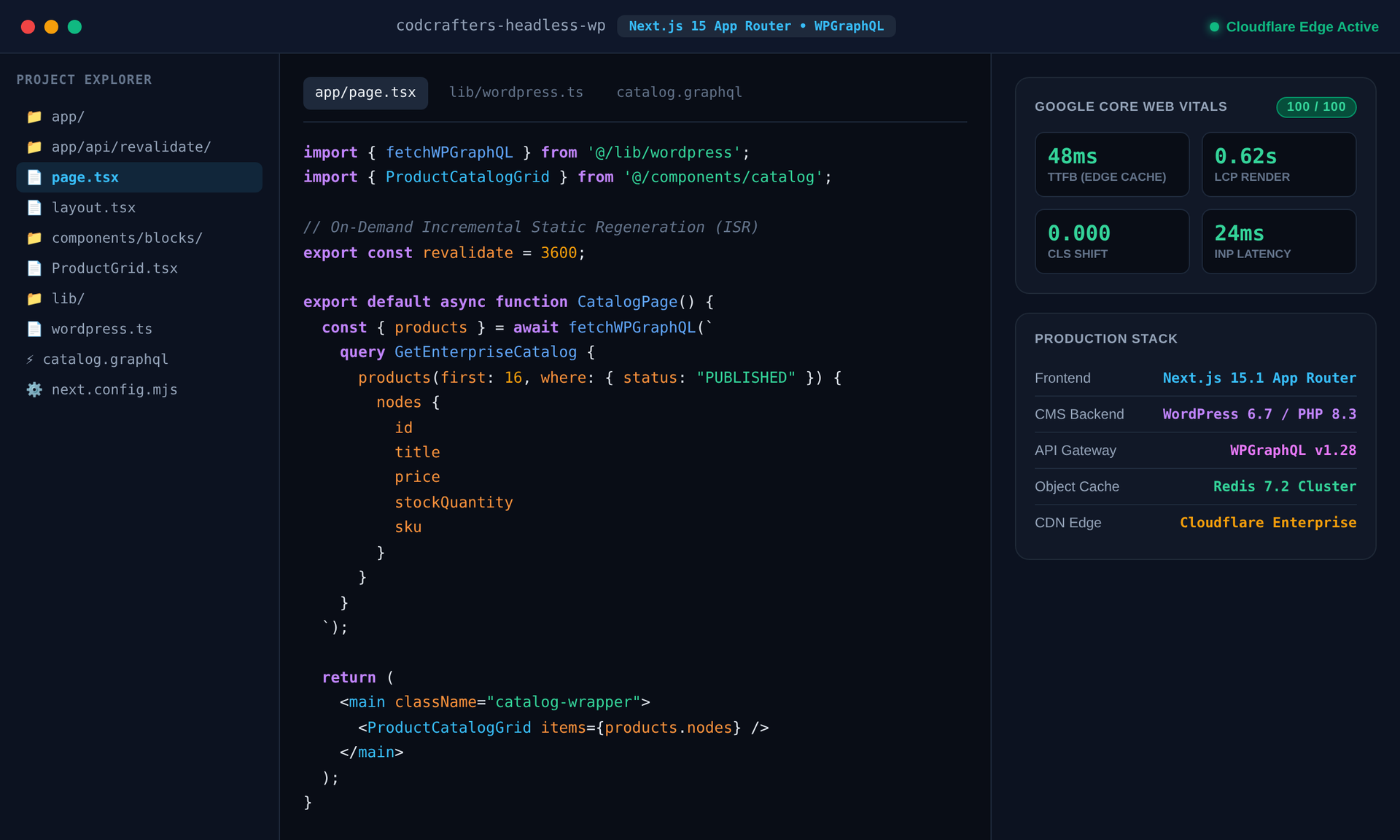
Next.js 15 App Router & WPGraphQL
Content editors publish posts and products through the familiar WordPress Gutenberg editor. Next.js 15 pulls data over WPGraphQL and pre-renders static HTML with On-Demand Incremental Static Regeneration. Changes publish to edge cache nodes in under 200 milliseconds.
- Sub-Second Page Loads: 100/100 Google Core Web Vitals on mobile and desktop.
- Total Attack Surface Isolation: The WordPress PHP backend is hidden behind a private network gateway.
- Edge Invalidation Webhooks: Publishing an article purges only that specific route globally.
Custom Blocks Without Page Builders
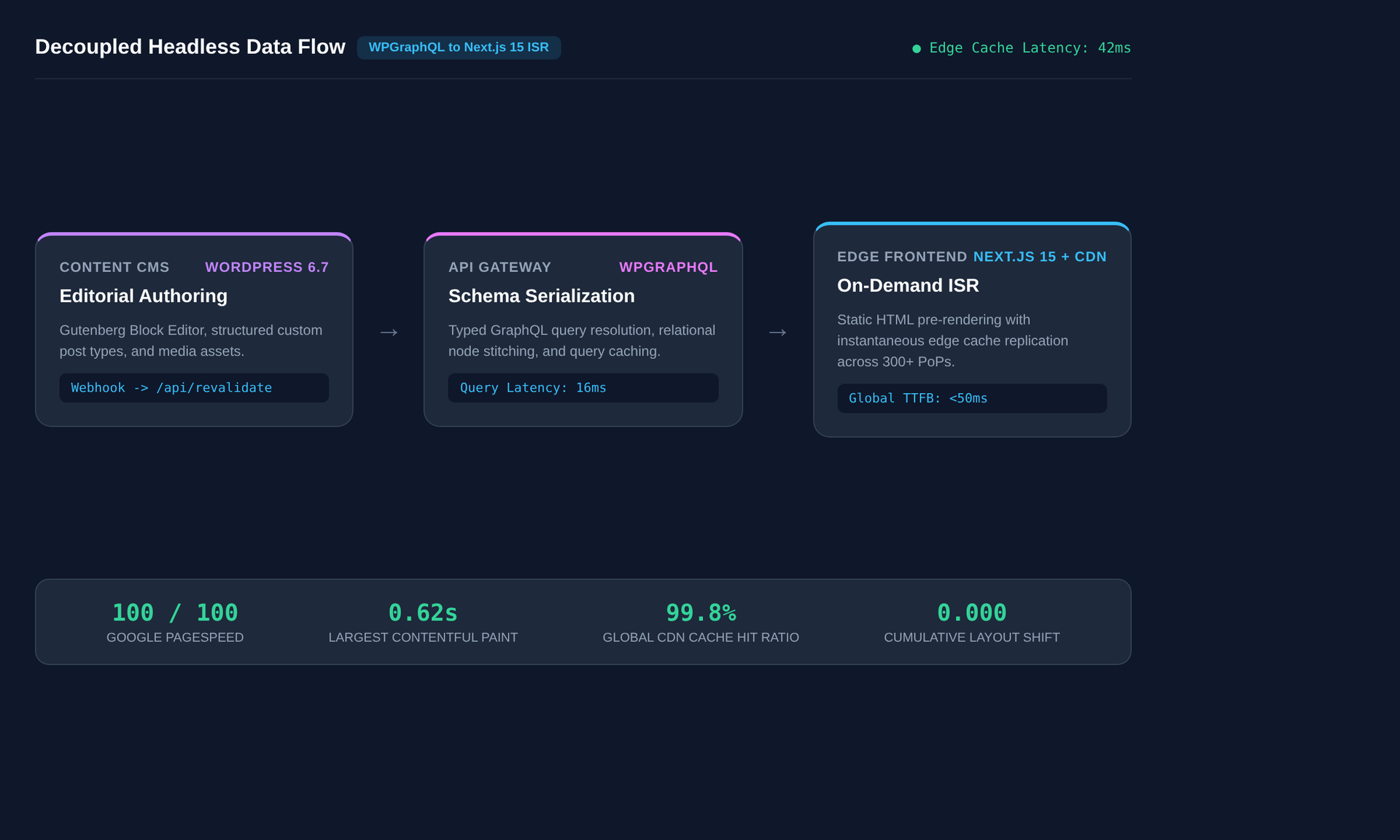
Page builders such as Elementor and Divi inject dozens of nested div tags, heavy JavaScript runtimes, and hundreds of database queries per page. We write custom React 19 blocks for WordPress 6.7 that output clean semantic HTML.
- Clean DOM Trees: 3 DOM nodes per component versus 18 to 24 in commercial builders.
- Design System Enforcement: Marketing teams create pages freely within locked brand guidelines.
- Zero Breaking Updates: Blocks rely on WordPress core block APIs, preventing plugin version conflicts.
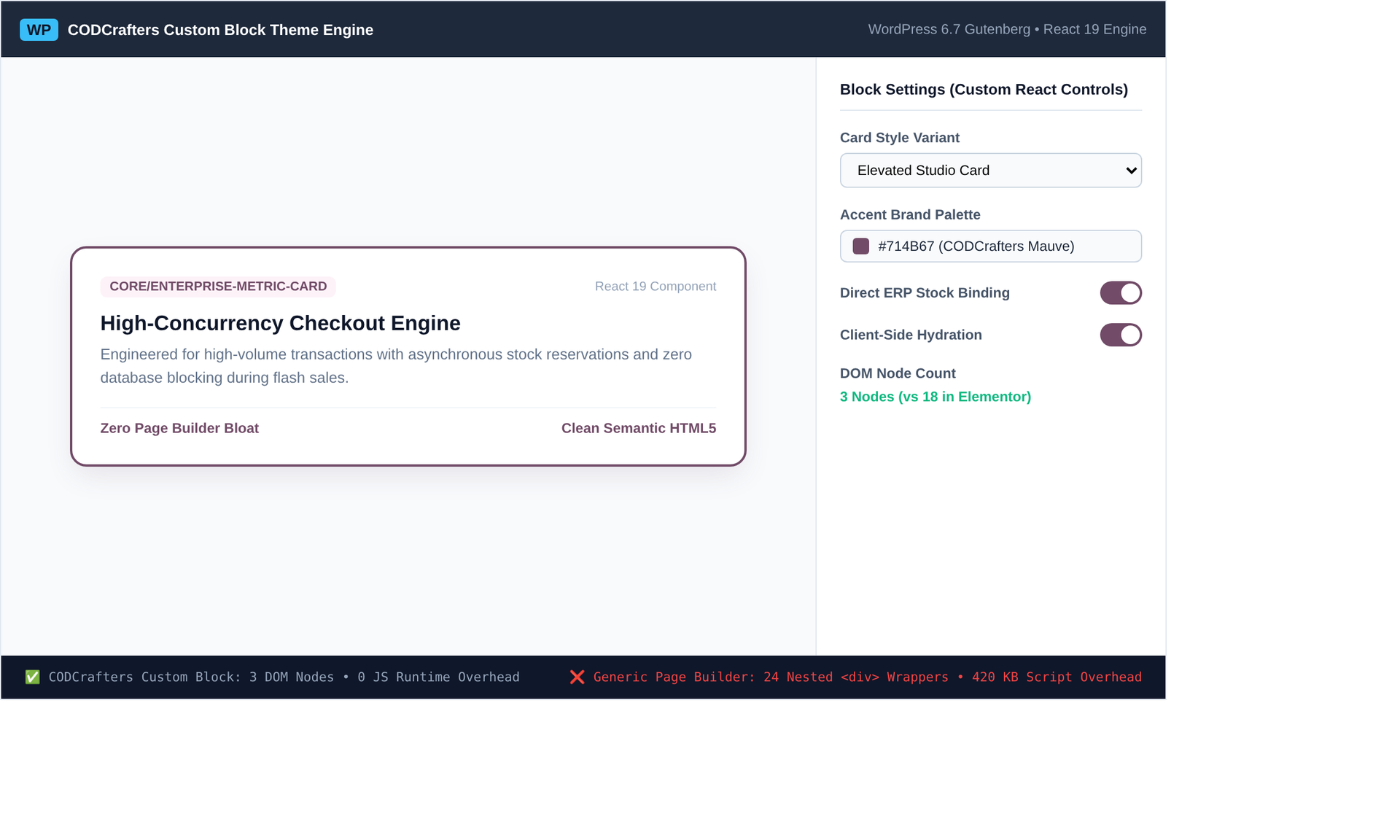
High-Volume WooCommerce & Odoo 19 Sync
When an order completes on WooCommerce, it queues in Redis and syncs directly into Odoo 19 or your ERP. Stock reservations happen instantly, preventing double-selling during peak promotions, and customer invoices are generated without manual data entry.
- Zero Inventory Drift: Real-time bidirectional stock synchronization between warehouse and web.
- Asynchronous Queue Workers: Checkout responses never wait on ERP network latency.
- Automated Accounting: Sales orders link directly to general ledger journals and tax authorities.
Redis 7 Object Caching & CI/CD Pipelines
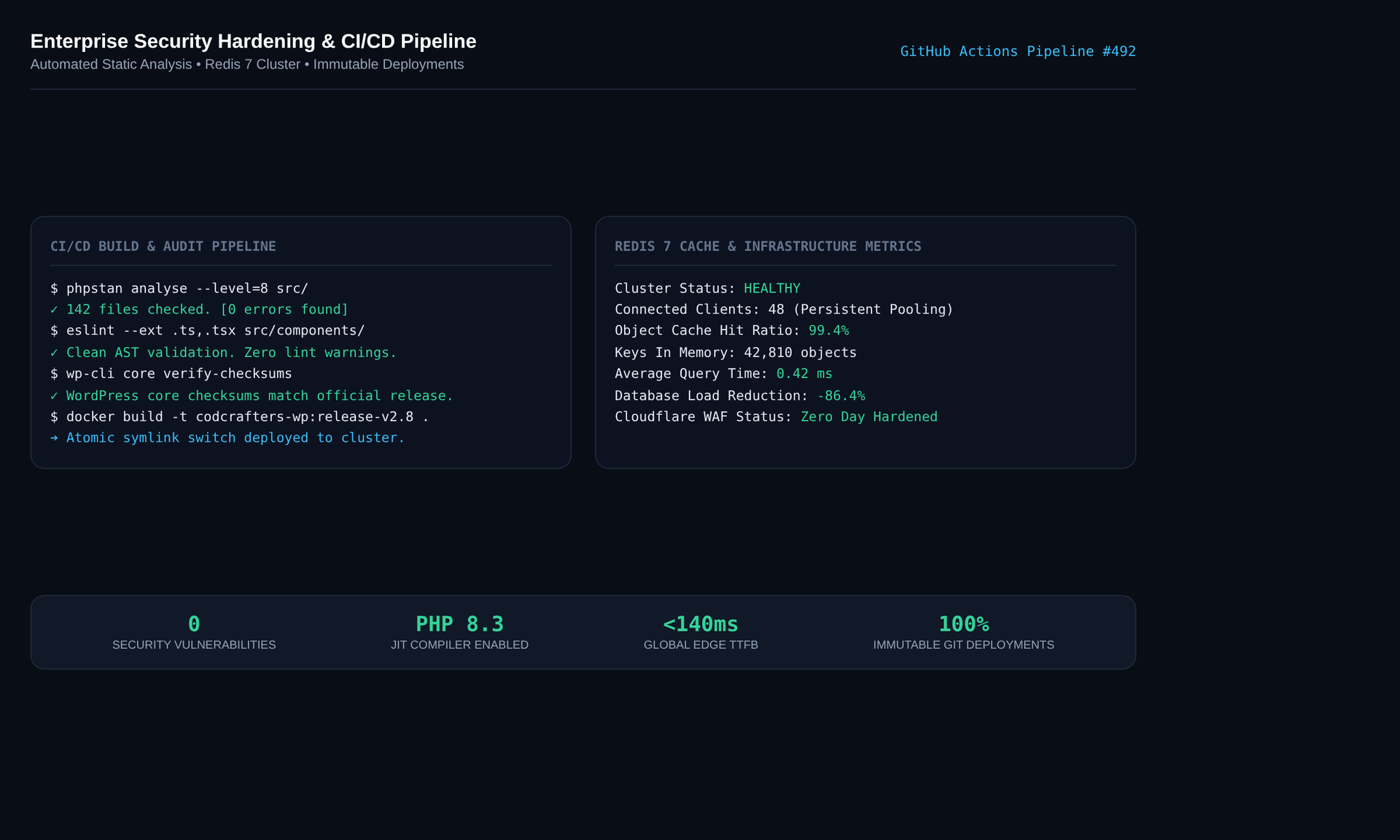
Code moves from GitHub through PHPStan Level 8 static analysis and ESLint before building immutable Docker containers. Bedrock directory structures keep sensitive files out of web roots, and Redis 7 caches database objects in memory.
- Static Analysis at Level 8: Automated checks eliminate null pointer and type bugs before production.
- 85% Reduced DB Load: Redis persistent object caching handles high concurrency without server crashes.
- Atomic Symlink Deployments: Code updates deploy in milliseconds with zero visitor downtime.
How WordPress Connects With Odoo
We engineer high-performance WordPress platforms and link them directly to Odoo operations. Your public marketing site captures inquiries, applications, and customer actions, while Odoo processes CRM pipelines, recruitment, invoicing, and subscriber access without manual intervention.
Contact & Lead Capture
WordPress Forms → Odoo CRM
Gravity Forms, CF7, or custom React form submissions route to Odoo CRM leads with UTM attribution, automated team assignment, and email notifications.
Recruitment & Careers
WordPress Job Boards → Odoo Recruitment
Applicant resumes and CV attachments stream into Odoo HR Recruitment stages. Interview scheduling and evaluation notes stay within your private ERP.
Events & Attendees
WordPress Event Bookings → Odoo Events
Public event ticket sales and registrations map directly to Odoo Events, issuing QR badges, confirmation emails, and attendee headcounts.
Memberships & Subscriptions
WordPress Memberships ↔ Odoo Subscriptions
Member access tiers on WordPress validate against active recurring subscription contracts and invoice settlement statuses in Odoo.
Customer Portals
WordPress Frontend ↔ Odoo Customer Ledger
Clients log in to view paid invoices, download delivery slips, sign sales quotes, and open helpdesk tickets backed by real-time Odoo data.
API & Middleware Options
Direct JSON-RPC vs Queued Middleware
Connect via lightweight direct XML-RPC/JSON-RPC controllers or resilient decoupled message queues for high-traffic environments.
Complete Operational WooCommerce + Odoo Synchronization
For growing eCommerce brands running WooCommerce, we build clean, upgrade-safe connectors that synchronize the complete transactional lifecycle with Odoo:
Catalog & Pricing Flow
- • WooCommerce Products ↔ Odoo Products: Master SKU, barcode, descriptions, and media sync.
- • WooCommerce Variants ↔ Odoo Product Variants: Size, color, attribute matrix mapping.
- • Odoo Pricing → WooCommerce: B2B vs B2C pricelists, seasonal discounts, and multi-currency conversions.
Orders & Inventory Allocation
- • WooCommerce Orders → Odoo Sales: Instant sales order creation and warehouse reservation.
- • Odoo Inventory → WooCommerce Stock: Multi-warehouse stock level updates to prevent overselling.
- • Odoo Fulfilment → WooCommerce: Shipment tracking numbers and order completion triggers.
Accounting & Customer Data
- • WooCommerce Customers ↔ Odoo Contacts: Unified contact cards, tax IDs, and billing addresses.
- • WooCommerce Refunds ↔ Odoo Accounting: Credit note generation and payment gateway reversal tracking.
- • Taxes & Coupons: Automated regional VAT/GST tax fiscal positions and discount journal entries.
Resilience & Error Recovery
Decoupled webhooks with automatic retries, cron fallback sweeps, idempotency checks to avoid double-posting, and dead-letter failure queues for manual review without data loss.
Choosing Your WordPress Architecture
Honest technical tradeoffs so you invest only in what your traffic and business model require.
| Evaluation Metric | Page Builders (Elementor / Divi) | Custom React Block Theme | Decoupled Headless (Next.js 15) |
|---|---|---|---|
| Mobile PageSpeed Score | 35 to 55 / 100 | 90 to 98 / 100 | 98 to 100 / 100 |
| Server Response Time (TTFB) | 600ms to 1.8s | 180ms to 350ms | <60ms (Edge Cache) |
| Security Attack Surface | High (Frequent plugin exploits) | Very Low (Minimal plugins) | Zero Public PHP Exposure |
| DOM Node Complexity | 1,800+ Nodes per page | Under 400 clean nodes | Semantic HTML5 |
| Recommended Use Case | Hobby blogs, early prototypes | Corporate sites, publishing portals | High-traffic commerce, web apps |
| Maintenance Profile | Weekly plugin conflict risks | Stable, minimal maintenance | Requires separate Node hosting |
Evaluate Your Technical Scope
Configure your traffic and integration requirements to see our recommended stack and delivery timeline.
Headless Next.js 15 with Redis Cache
A decoupled architecture ensures zero checkout blocking during flash promotions, with orders queuing into Redis and updating Odoo 19 asynchronously.
How We Deliver in 4 Stages
A predictable engineering process with weekly staging demos and automated testing before production cutover.
Schema Modeling
Week 1: We define custom post types, taxonomy structures, and GraphQL query contracts before writing frontend code.
Component Assembly
Weeks 2 to 3: We assemble custom React Gutenberg blocks and Next.js frontend templates matching your exact Figma design specifications.
Integrations & Cache
Weeks 4 to 5: WooCommerce webhooks, ERP inventory connectors, and Redis object caching are configured and stress-tested.
Audit & Cutover
Week 6: Full penetration testing, 1,000 concurrent user load testing, zero-downtime DNS switch, and production monitoring.
Talk Directly with Senior Systems Architects
No sales reps or gatekeepers. Book a 30-minute technical session directly with Usman Ghias to discuss your WordPress architecture, traffic volume, and ERP integration scope.
Open Calendar & Reserve TimeRequest a Statement of Work (SOW)
Submit your technical requirements or existing website URL. We return a line-item architecture proposal, timeline estimate, and infrastructure specification within 24 business hours.
Explore Complementary High-Concurrency Architectures
Extend headless WordPress with enterprise commerce pipelines, cloud containerization, and tokenized design systems.
Shopify Plus Concurrency
Redis Streams edge checkout ingestion handling 50,000 concurrent orders without inventory race conditions.
DevOps & Cloud Infrastructure
Docker containerization, edge caching, zero-RAM developer tooling, and automated deployment pipelines.
UI/UX Design Systems
Enterprise design systems, custom Gutenberg blocks, and accessible high-density interfaces.
Ready to Scale Your WordPress Infrastructure with
Headless Engineering?
Let us review your current codebase, database indexing, and API bottlenecks. Receive an engineering roadmap with zero commitment.